GRC as the compass
We connect obligations, risk appetite, controls and evidence in a usable governance baseline.
Output: priorities and ownership.VISIONCYBERX connects business risk, regulation and technology choices in one defensible roadmap for IT, OT and IoT.
 VISION / EUROPEEuropean perspective · independent selection
Many organisations already have an extensive security stack. Ownership, priorities and evidence can still remain fragmented. That makes investment hard to direct and outcomes hard to defend.
As an independent broker, VISIONCYBERX starts with business context and maturity. We translate obligations and threats into a coherent plan, then qualify the solutions and partners that fit it.
Our model connects governance to execution and keeps technology selection open until the requirements are clear.
We connect obligations, risk appetite, controls and evidence in a usable governance baseline.
Output: priorities and ownership.We assess vendors and integration partners for fit, sovereignty, operational impact and commercial terms.
Output: informed choices.We connect detection, response and validation to reporting that both a CISO and a board can use.
Output: risk-reduction evidence.A connected chain of capabilities shaped by your risk and operating environment.
Risk assessment, maturity reviews, control mapping and programmes spanning NIS2, DORA, ISO 27001, ISO 42001, GDPR and AI governance where relevant.
Target architecture for endpoint, identity, network, cloud and industrial environments, with continuity as a design constraint.
Requirements, RFP leadership, shortlisting, PoC governance, contract alignment and implementation partners.
SOC/MDR design, incident readiness, continuous validation, remediation and executive reporting.
We assess the applicability of legislation and standards by organisation, sector and role.
VISIONCYBERX puts European sovereignty into technology selection: who controls the service, where information is processed, who can access it and how your organisation can keep operating or change provider.
Assess hosting, processing locations, subprocessors, administrative access and the laws that apply.
Validate deployment options, integrations, encryption-key ownership and control over telemetry and AI use.
Evaluate technology dependencies, contractual safeguards, portability and a workable exit plan.
Belgian GRC provider connecting obligations, controls and evidence. EURAIKA states that its infrastructure and data residency are EU-based, with transparent AI and human oversight.
Explore EURAIKAEuropean security platform for endpoint detection and protection. Cloud and on-premises deployment options, accessible detection rules and APIs support control over the security architecture.
Explore HarfangLabAmsterdam-founded SecOps provider combining AI agents, automation, investigations and forensics. Its AI Fabric offers private AI infrastructure for SOCs and MSSPs, with control over models and inference.
Explore ImperumWe verify sovereignty against the selected architecture and contract, including hosting and dependencies. European origin is a starting point; the operating model must meet your requirements.
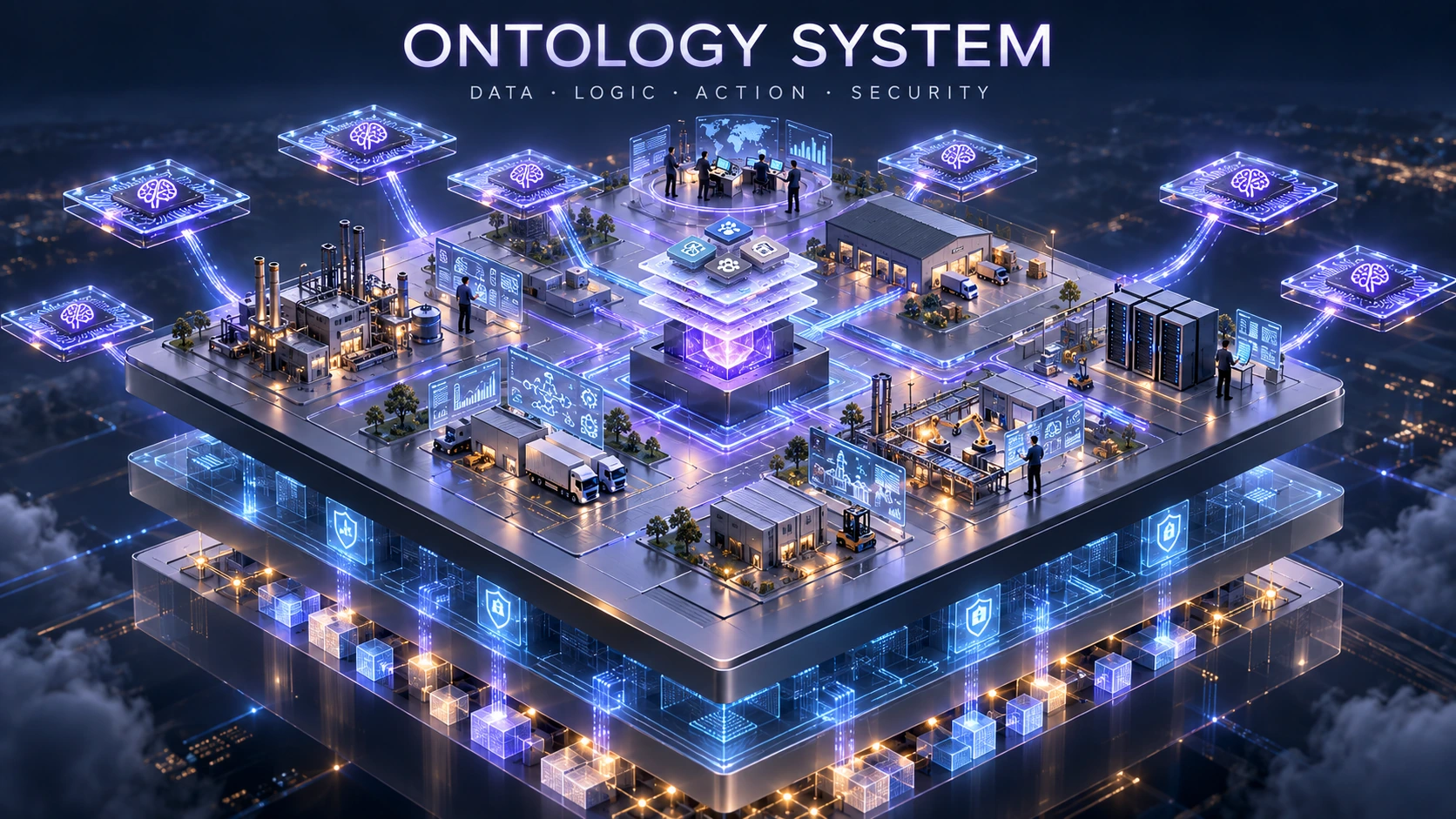
An ontology defines your organisation's concepts and the relationships between them. It gives fragmented information a shared structure that people and AI can use.
VISIONCYBERX uses Nextnet for the ontology layer. Nextnet connects enterprise information through explicit entities and relationships, with source traceability and permission controls. Copilot supports natural-language exploration; Explorer makes connected knowledge visible.
We bring the business context: critical processes, information ownership, governance requirements and the decisions your organisation needs to support.
Define entities and relationships across documents, systems and datasets.
Connect insights to the underlying sources and their context.
Align access, ownership and use cases with your organisation's requirements.
Each phase creates a decision that operations, the CISO and the board can understand.
Map GRC maturity, critical processes, threats and the IT/OT context.
Define control priorities, architecture and budget guardrails.
Test vendors, proofs of concept, partners and contracts against clear criteria.
Measure performance, close findings and report residual risk.
Outcome: a vendor-neutral roadmap with compliance traceability, commercial clarity and board-ready evidence.
ASSESS → DESIGN → QUALIFY → VALIDATEConnect obligations, operational risks and control evidence in one managed programme. VISIONCYBERX aligns governance with the realities of IT, OT and AI, so leadership can prioritise, assign ownership and follow progress.
We establish applicability and scope, then map relevant EU obligations, management standards, national schemes and sector requirements. Shared measures — access control, asset management, incident response, supplier assurance and recovery — can reuse evidence when scope, timing and assessment criteria match.
Binding EU rules, subject to scope and national transposition where relevant.
EU directive on cybersecurity governance and incident reporting for essential and important entities.
View framework page →EU regulation protecting personal data and the rights of individuals.
View framework page →EU digital operational resilience regulation for financial entities.
View framework page →EU cybersecurity requirements for products with digital elements made available on the EU market.
View framework page →Five management system standards and the voluntary NIST CSF. Certification relates only to an eligible standard and a defined scope.
International requirements for an information security management system.
View framework page →International requirements for a quality management system.
View framework page →International requirements for an environmental management system.
View framework page →International requirements for an AI management system.
View framework page →International requirements for a business continuity management system.
View framework page →Voluntary framework for managing and communicating cybersecurity risk.
View framework page →Belgian, French and German reference points. ANSSI and BSI are authorities, not single standards.
Belgian CyberFundamentals framework with practical controls and assurance levels.
View framework page →France's national cybersecurity agency publishes security guidance and qualification schemes.
View framework page →Germany's federal cybersecurity agency maintains IT-Grundschutz and other security publications.
View framework page →Requirements used in particular supply chains and payment environments.
Automotive information security assessment and exchange mechanism operated by ENX.
View framework page →Industry security standard for environments handling cardholder data.
View framework page →Each framework retains its specific obligations, reporting duties and assessment criteria. Cross-mapping supports implementation; it does not establish automatic equivalence or certification.
Industrial automation and control systems need security throughout their lifecycle. We apply ISA/IEC 62443 principles with safety, availability and process continuity as operational requirements.
Define the system under consideration, group assets into security zones and control communications through conduits. Assess the risk of each zone and conduit.
Determine target security levels (SL-T) from risk. Separate required protection from component capability (SL-C) and the security achieved by the integrated operational system (SL-A).
Combine segmentation, controlled access, system integrity, monitoring and recovery. Validate changes and maintenance against the constraints of the industrial process.
Make the roles of asset owners, integrators, service providers and product suppliers explicit. Align secure development, integration, operation and maintenance.
The seven foundational requirements cover identification and authentication, use control, system integrity, data confidentiality, restricted data flow, timely response to events and resource availability.
B.L.A.C. tests technical choices against value, responsibility and continuity.
Security connected to strategy, value and critical operations.
Visibility into obligations, contracts and the ownership of risks and controls.
Clear decisions, responsibilities and measures.
Resilience as an ongoing governance and operational responsibility.
The result is cyber decision-making that boards and auditors can read and teams can test in practice.
A phased entry path brings risk, architecture and sourcing together. The exact scope follows your context.
Discuss an engagementRisk appetite, obligations, existing stack and critical services.
Maturity view, capability map and quick wins.
Shortlist, PoC plan, partner roles and commercial analysis.
Evidence, residual risk, roadmap and investment decisions.
Intended output: an actionable investment roadmap with evidence-based priorities.
Tell us which obligation, technology choice or resilience question is on the table.